Double column backwash screen changer
In extrusion production, the fast clogging of filter screens and high frequency of manual screen replacement have always been pain points affecting continuous production in recycling granulation, sheet film and other production lines. If you want to reduce the workload of manual screen replacement and extend the service life of the filter screen, the double column backwash screen changer is a filtration solution worth evaluating.
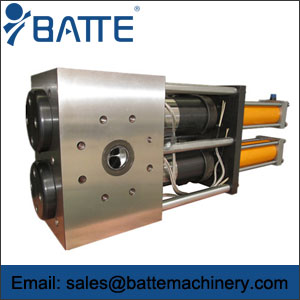
1、 Working principle of double column backwash screen changer
The core value of the double column backwash screen changer is to automatically remove impurities accumulated on the surface of the filter screen online, achieve filter screen reuse, and extend the manual screen replacement cycle. It is particularly suitable for production lines with high impurity loads and requiring long-term continuous operation, such as recycled plastic granulation production lines.
The workflow is divided into four stages: normal filtration → backwashing → impurity discharge → restoration of filtration. Under normal filtration conditions, the melt flows through the filter screen along the process flow, and impurities are trapped on the surface of the filter screen. As impurities continue to accumulate, the pressure difference before and after the filter gradually increases, and the flow resistance increases. After reaching the set threshold, the backwash process is initiated. The equipment switches through internal flow channels to guide a small portion of the molten material to reverse wash the filter screen to be cleaned, peel off the loosely attached trapped substances on the mesh surface, and discharge them through a dedicated discharge channel; After the flushing is completed, the filter screen of the workstation is put back into the melt filtration.
Important technical note: Backwashing can only remove impurities that are loosely attached to the surface of the filter and have not been sintered or solidified with the mesh body. Stubborn pollutants that have already been carbonized, embedded in the mesh, and fused with the filter cannot be removed by reverse melt flushing. These impurities still need to be manually removed and replaced. In short, the backwash screen changer is not a screen replacement free device. It adds an online self-cleaning process between two manual screen replacements to extend the interval between filter screen usage. Before selecting, the applicability can be simply judged by dismantling the waste net: if the waste net is mainly composed of loose attachments, the backwash effect is significant; If the filter screen has a large amount of hardened carbon black clumps, the backwash lifting space is limited.
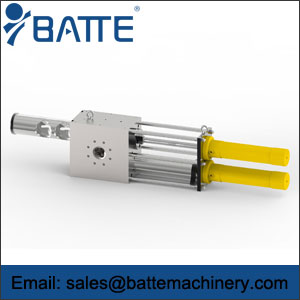
2、 Core features of dual column four station backwash screen changer
Double column four station backwash screen changer, integrating multi station filtration structure and online backwash function, with three major technical advantages:
Four station structure, large filtration area, non-stop screen changing, four channel four station design, with four filter screens synchronously participating in filtration during production, achieving a large filtration area inside a compact chamber, and matching specifications according to production capacity and filtration accuracy. When performing screen replacement, feeding, and exhaust operations, the other three sets of filter screens should maintain normal filtration to ensure continuous melt transportation and effectively suppress pressure fluctuations during the screen replacement process. For production lines that require high continuity of discharge, such as plates, sheets, and films, stable feeding characteristics are particularly crucial.
Online backwashing reduces the frequency of manual screen replacement by relying on the built-in backwashing function to clean impurities on the screen surface online, achieving repeated use of the filter screen and significantly reducing the consumption of filter consumables and manual disassembly operations. When evaluating technology, we cannot only focus on the effectiveness of the provincial network. We need to pay attention to three indicators simultaneously: the service life of a single filter screen, the number of manual screen changes per month, the amount of material loss from a single backwash discharge, and comprehensively calculate the overall operating cost.
The entire PLC automation control system adopts PLC closed-loop control, and the backwash trigger cycle, channel valve group switching, and action timing are all automatically executed by preset programs. No need for operators to manually judge the timing and operate step by step, reducing the risk of human error.
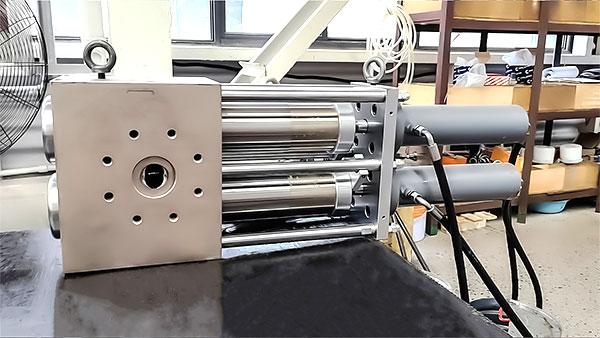
3、 Applicable process scenarios
The double column backwash screen changer is suitable for various thermoplastic melt filtration scenarios such as sheet metal, film, synthetic fiber, strapping, granulation, etc. The core recommended scenario is high impurity load conditions such as regeneration, recycling, and granulation.
The production line filter screen is frequently clogged due to the accumulation of impurities, and we hope to extend the filter screen cycle;
Long term uninterrupted continuous production is required;
The workload of manual network replacement is large, and we hope to reduce the intensity of on-site operations.
Selection tip: When describing operating conditions to equipment manufacturers, do not only consult equipment production capacity. As both recycling and granulation production lines, some demands focus on reducing the cost of filter consumables, while others prioritize ensuring stable melt pressure during the screen replacement stage, resulting in significant differences in equipment configuration schemes.
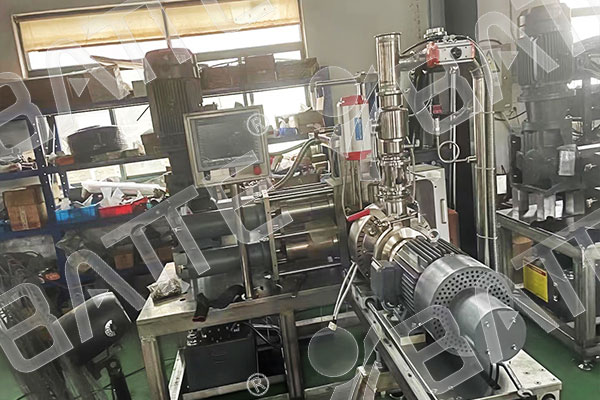
4、 Key points for matching production line selection
During the selection stage, it is necessary to provide the equipment manufacturer with the following information: material type, impurity type, hourly output, filtration accuracy requirements, working temperature, and inlet and outlet pressure parameters. The existing production line can provide additional information on the current screen replacement frequency and the impurity status of the disassembled filter screen, making it easier to accurately calculate the filtration area and equipment specifications. The scheme design needs to comprehensively balance the backwash cleaning effect, backwash discharge loss, and continuous production requirements. Attention: Even with a backwash structure, the filter is still a consumable part. After long-term operation, if the mesh is permanently blocked or damaged, it still needs to be stopped for replacement.
Zhengzhou Batte can customize matching double column backwash screen changers, hydraulic drives, and electronic control systems based on actual on-site working conditions. For extrusion production lines that want to improve the frequent clogging problem of the filter screen and enhance the continuous operation capability of the melt filtration process, an adaptation plan can be evaluated based on the existing filtration conditions.
Email: sale@meltpump.com
WhatsApp: +86 158 3833 1071